Desert ecologist Katie Fite (Biodiversity Director of Western Watersheds Project) is this week's guest on the Sagebrush Variety Show. She explains some of the problems with the Boulder-White Clouds bill (CIEDRA) and the Owyhee Initiative. Here are links to some of the sites she recommends:
Western Watersheds Project
RangeNet
Waste of the West: Public Lands Ranching
Alliance for the Wild Rockies
Owyhee Initiative: A Quick Overview
23 May 2006
21 May 2006
Bucky's Supplementary Links for Episode 37
http://homefront.silverwarethief.com/
http://www.boggycreekfarm.com/pages/the-hen-house.php
which I discovered while researching shows but which never made itheir way into this week's episode

15 May 2006
Bucky's Episode 36 Links for
Heres the link to the NY Times article Migrating Birds Didn't Carry Flu that inspired my spoof of the week. Of course you have to sign up as a free member to view it although I've been told that if you google the title of their articles you might get a direct link.
Whenever I mention any bird flu link I always do an obligatory shout out to the master of all bird flu (and public health) blog, Effect Measure. He's kinda soft on factory farming compared to me but he really knows his science and is one of the few people who actually understands the concept of "objectivity" so I figure if I'm not contradicting Effect Measure I'm probably being pretty reasonable.
Arugula
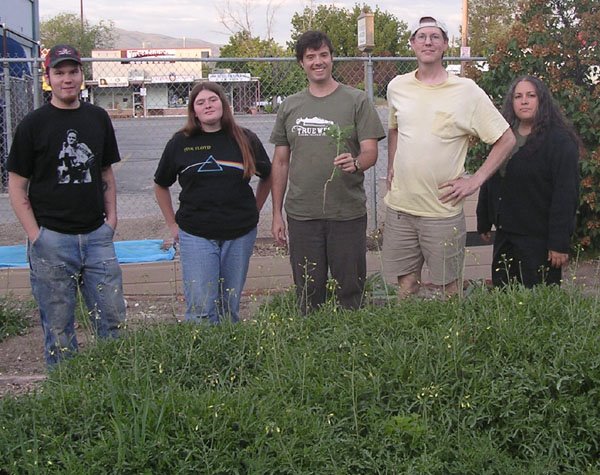
 The variety we grow at Sagebrush Variety Show Farm is called selvatica aka wild arugula. It takes a little longer to germinate than the cultivated kind, but once you plant it, it'll easily self-sow itself year after year. Even though it's supposed to be an annual, it perennializes, which means the roots don't die in the winter and grow leaves again every spring.
A good way to eat it is in a salad--by itself or with other greens--with a dressing made of olive oil, fresh lemon juice, and grated raw garlic. For a creamier variation that sticks better to the leaves, whip some applesauce into the dressing.
Arugula is also good in sandwiches or chopped into pasta salads. You can make a pesto out of it, too.
Here's a link to groovy arugula nutrition facts.
11 May 2006
Sagebrush Resource
On a previous edition of the Sagebrush Variety Show we featured an interview with Alan Durning, President of Northwest Environment Watch on sustainability issues and trends in the Northwestern region known as Cascadia. Podcast Sagebrush Variety Show #30 to hear it.
Just a few weeks later the Sagebrush players received an an email from Alan Durning explaining that after 14 years as Cascadia's sustainability think tank, Northwest Environment Watch has changed its name to Sightline Insitute. (they say the name Sightline better reflects what they do in helping us see a clear way to a better future for us all).
The name change is just an opener to the big news that they’ve revamped their website Sightline.org to make the most of the institutes comprehensive research, statistics, news and dialogue.
There are some excellent new features.
Like the Maps and Graphics Center with close to 100 maps, charts, and animations illustrating trends such as gasoline consumption, changes in human health, and pollution in northwesterners. All available for downloading and printing or computer vieiwng. The graphic maop of clearcutting in the Central Cascade forest is a real eye-opener ad is the chart showing the increased levels of PBDE levels in blood and tissue samples of north american humans since the 1980’s. PBDE is a flame retardent chemical used in many priducts that can cause neurological and reproductive damage.
The publications section features Sightline books and reports available in full text pdf, on each of the issues that they track--such assprawl and transportation, energy, health, and economy.
An active blog—called the Daily Score—with running commentary on the latest news. Some of the latest entries include Alan’s frankly funny yet inspiring diary of his families attempts to live a year in Seattle without owning a car, a report on the latest scientific findings regarding bird intelligence (Sagebrush’s own Bucky Buckaw already knows birds are at least as smart as humans but it’s nice to see the scientific com muntiy catching up), and a really great explanation of how “booming conomy” can mean different things depending on who’s talking and that GDP doesn’t necesarilly mean good for working schmoes.
The name Cascadia refers to an ecological, economic and cultural region including British Columbia, Idaho, Washington, and Oregon which is most instructive to look at as a whole. However, the new website function that allows viewers to browse or search for Idaho-related information only, for example, is a useful way to manage the wealth oif information Sightline offers.
Sagebrush Variety show highly reccomends our viewers make use of the website. There’s an incentive to join as an emailsubscribers in that subscribers get special features-such as complete access to Sightline’s work, including free pdfs of books and reports; and downloads of high-quality maps, charts, and graphics, their email newsletters, and the abilty to add your own comments to their blog.
Plant sales and planning for the season
 Listeners who heard our interview with Diane Jones of Draggin' Wing Farms might be interested to know that there will be a native plant sale this weekend.
Saturday & Sunday, May 13 & 14, 9 am to 3 pm at Castle Drive and Hill Rd. The farm is just off that intersection on Stinger St but there will be signs directing you there.
Also, Draggin' Wing Farm neighbors Peaceful Belly Farm will be selling heirloom tomato plants at $4 each.
Don't feed your loved ones a trite tomato - grow your own! (or at least get some decent varieties from farmers markets/stands)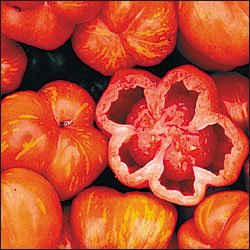
The Sagebrush Players support backyard gardening and xeriscaping. In fact, we've been growing our own tomatoes already at Sagebrush Variety Show Farms. This year's tomato varieties:
Red Brandywine - the king of heirloom tomatoes
Green Zebra - not an heirloom, but still worth growing for its green color with yellow stripes, great flavor, and ease to grow
Paul Robeson - smallish black heirloom from Russia named after the singer, communist, and equal rights activist
Black from Tula - larger black, Ukrainian heirloom
Black Prince - a smallish red-brown heirloom from Irkutsk that does particularly well in Idaho.
(okay, so we have a thing for black tomatoes)
Yellow Bell - a productive, yellow paste heirloom from Tennessee that grows well here. Great for stuffing with hummus on the run, too.
Big Rainbow - large, multicolored heirloom
Orange Banana - prolific, orange, heirloom paste tomato that's also good for eating and drying.
Striped Cavern - orange-striped red tomato that is shaped like a bell pepper and hollow inside.
Evergreen Emerald - largish all-green tomato
Just reading the brief descriptions of this handful of varieties should make you angry about how corporate farming and food distribution has robbed us of the diversity in our produce--and this is just looking at tomatoes.
08 May 2006
Sagebrush vs. the Laws of Thermodynamics
Listeners who missed last week's premiere of Corporate Prime, our latest serial drama, can check it out again this week. We lost our regular battle with Entropy this week, so last week's show will be re-broadcast.
April and Khalil have finals, Jeremy was kidnapped by his mates for his birthday, Lea is spending a few weeks on the coast for her health, Curtis is helping refugees plant a community garden, and Kevin, Robert, and Gwen are being their usual overextended selves.
Corporate Prime, written by Kevin, is a straight drama (no comedy this time) about life after Peak Oil, after the corporations succeed in taking over all aspects of our lives, and after the U.S. loses its place as the imperial superpower. All this takes place in Idaho, starting in New Arco City. Okay, well, it has a tiny bit of humor in it.
Some listeners might be disappointed to learn that there are no characters based on Dirk Kempthorne this time, but if you really are looking for entertainment based on the Bush administration's latest cabinet appointment, we recommend that you listen to Snow Blow Hard: Xmas with a Vengeance or its sequel, Eternal Quest, for a character very much based on the public figure, in a very satirical way, of course, using examples from real life to move the story along. Alas, we can't tell you which are true and which are fiction, but just keep in mind that often life is stranger than fiction.
I will give you a few hints, though. Kempthorne is indeed very much preoccupied about being perceived as an important person. And you can read about his dream to travel the nation by selling burgers from a grease truck in any newspaper. And what politician is complete without their very own scandal? As a testament to his cognitive skills, allow me to quote him on CAFTA: "I support free trade and fair trade." And I have repeatedly spotted Dirk in the seasonal crap section of Fred Meyer staring at clearance holiday items, as if they were cultural artifacts on display in a museum. And he did have a pet highway project that could best be described as "cockamamie."
I could go on and on, but you could just listen to the shows. Just download them! And don't forget about the Kempthrone's Castle skits, either, which are fictitious proclamations that take place on the grounds of the former Simplot mansion.
19 April 2006
Bucky Scooped Jim Hightower
Just heard a report on that infernal NAIS from Jim Hightower (for my report see archived Sagebrush Variety Show #30). Not to brag too much - I was a bit ashamed that the NAIS was publically released in 2005 and I didn't hear about it until February of this year. Also, Mr. Hightower caught something I missed, the fact that big agribusiness operations get "bulk discounts" on tagging fees.
12 April 2006
Sagebrush Week of 4/10/06
We've got another Eye-Opener (there may be only one or two more coming, as the legislative session is about to end); April wrote a rant on the anti-gay marriage amendment in Idaho; Part 3 of The Dolphinarium (the chilling conclusion comes on next week show); Bucky Buckaw further unravels the nefarious secrets and moneydealing behind the avian flu hysteria; an interview with John Barrett, Interim Executive Director of Idaho Smart Growth on transit options in Idaho; and what will no doubt get us some fan/hate mail, a piece by Robert Blurton on composting human excretion.
Send us your feedback, good or bad, to sagebrush-at-radioboise.org.
03 April 2006
Bucky's April Avian Flu Links
My latest favorite source for information on sustainability, biodiversity and democracy in agriculture, GRAIN.
For a mainstream article on Rumsfeld's Tamiflu fortune CNN
Chuck Schumer's heroic efforts to insure no Tamiflu is left unsold in his own words
And a piece on the Tamiflu-related run on star anise from National Geographic
28 March 2006
2006 Captain Hook Awards
Aar! The recipients of this annual set of awards given to leaders in biopiracy have just been announced! We did our best to deliver them in our best pirate voices. Here's the list:
- Worst Threat to Food Sovereignty: Syngenta
- Greediest Biopirate: J Craig Venter
- Biggest Threat to Genetic Privacy: Google: Indexing Your Genes
- Extreme Makeover Award: Delta & Pine Land
- Most Shameful Act of Biopiracy: US Government
- Worst Déjà Vu: Human Genographic Project
- Access of Evil Award: Canada, Australia, New Zealand
- Biggest Tiny Claim On Nature: Nanosys, Inc.
- Worst Betrayal: Genencor et al.
- Most Hypocritical - Joint Winners: University of California-Davis and The Biotechnology Industry Organization (BIO)
25 March 2006
The Commercial Empire Strikes Back
Khalil's rant on why big-box stores sap the local economy applies not only to Wal-Marts, but also any national chain stores, fast-food joints, and shopping centers. Here are the stats:
small retail stores (local) average +$326 per 1000 sq ft
large retail chains average -$468 per 1000 sq ft
fast-food chains average -$5168 per 1000 sq ft
shopping centers average -$314 per 1000 sq ft
These numbers in red are deficits passed onto the local taxpayers, mainly in the form of road building and maintenance and crime-related costs. Never mind all the other dollars lost from not using local vendors and suppliers such as printers and advertisers.
Some links:
Local ownership pays off for communities
As police costs rise, towns reconsider big boxes
21 March 2006
Alan Thein Durning Interview
Gwen Sanchirico talked with Alan Durning of the Northwest Environment Watch (NEW) while he was in Idaho for various conferences, talks, and presentations on sustainability and how societies should define progress. They talked about approaching sustainability issues from different angles.
NEW takes the ecoregion of Cascadia and evaluates it on seven factors:
- pollution
- health
- economy
- population
- energy
- sprawl
- forests
Dirk Kempthorne Spotlight
Now that Idaho Governor Dirk Kempthorne has received so much attention from outside the state after having been nominated as the new Secretary of the Interior, this might be a good time to go back to the Sagebrush archives and listen to Snow Blow Hard (even though it's really an end-of-year type story). See how many similarities there are between the character Duke Bramblevine and the current commentary in the national press. It's fun, and a lot of it is based on reality.
20 March 2006
National Animal Identification System (NAIS) Episode
For those of you having trouble taking Bucky Buckaw's word for it that the USDA is competing with the Department of Homeland Security for most intrusive agency in American History go to the USDA site on NAIS and poke around for yourself.
Then get the opposition viewpoint and ways to oppose NAIS from the No-NAIS site and, for something specifically geared to us chicken lovers American Bantam Clubs PDF of NAIS
Then, just for fun, look at some pictures of Silkie and Auracana breed chickens at Brown Egg Blue Egg and then ask yourself would you want a world where all the chickens were factory issue broilers? I mean deep down they have the same chicken charm as the "exotics" but once you've seen one you've seen them all. Bred for an average life expectancy of 1 year and to break their own legs by the very act of growing up!
15 March 2006
Terry Shepard, Friends of the Liberty Tree
This week's interview is with Terry Shepard, President of Friends of the Liberty Tree. His bill to recognize April 19 as Patriots Day in Idaho was recently passed by the state legislature, and he hopes to have a tree in Capitol Park (across the street form the Idaho capitol) dedicated as a Liberty Tree. To learn more about the project, you can contact Terry at 208-602-2387.
08 March 2006
Sagebrush Variety Show on Radio Free Moscow
Radio Free Moscow KRFP (92.5 FM) is trying out Sagebrush Variety Show Monday afternoons, 4-5pm PST. If you live in the area, you can tune in, even in your economy car!
This Week's Sagebrush
We've got the latest UV-Eye-Opener and a Sagebrush Transit Report, along with some older bits. As of next week, be prepared to 100% all-new material, starting with the conclusion of Eternal Quest. If you're a new listener, you might want to download the podcast containing the entire series (up until the cliffhanger, of course).
02 March 2006
Alan Thein Durning in Idaho
We mentioned that the piece we did on coffee was based on Stuff: The Secret Lives of Everyday Things by John C. Ryan and Alan Thein Durning. Thurning will speak at BSU on Friday, March 3 at 7pm in the Student Union Building--and it's free. We highly recommend going.
There will also be a reception with Durning that Idaho Smart Growth is hosting on Saturday, March 4 5:00-6:30 pm at the Idaho Integrated Design Lab at the corner of 6th and Main in Boise. To RSVP for this event ($40) call the ISG office at 333-8066.
Sagebrush will be there, of course, so if you can't make either event, you will get to hear about it on RadioBoise.org!
Subscribe to:
Posts (Atom)